
 Laura
Laura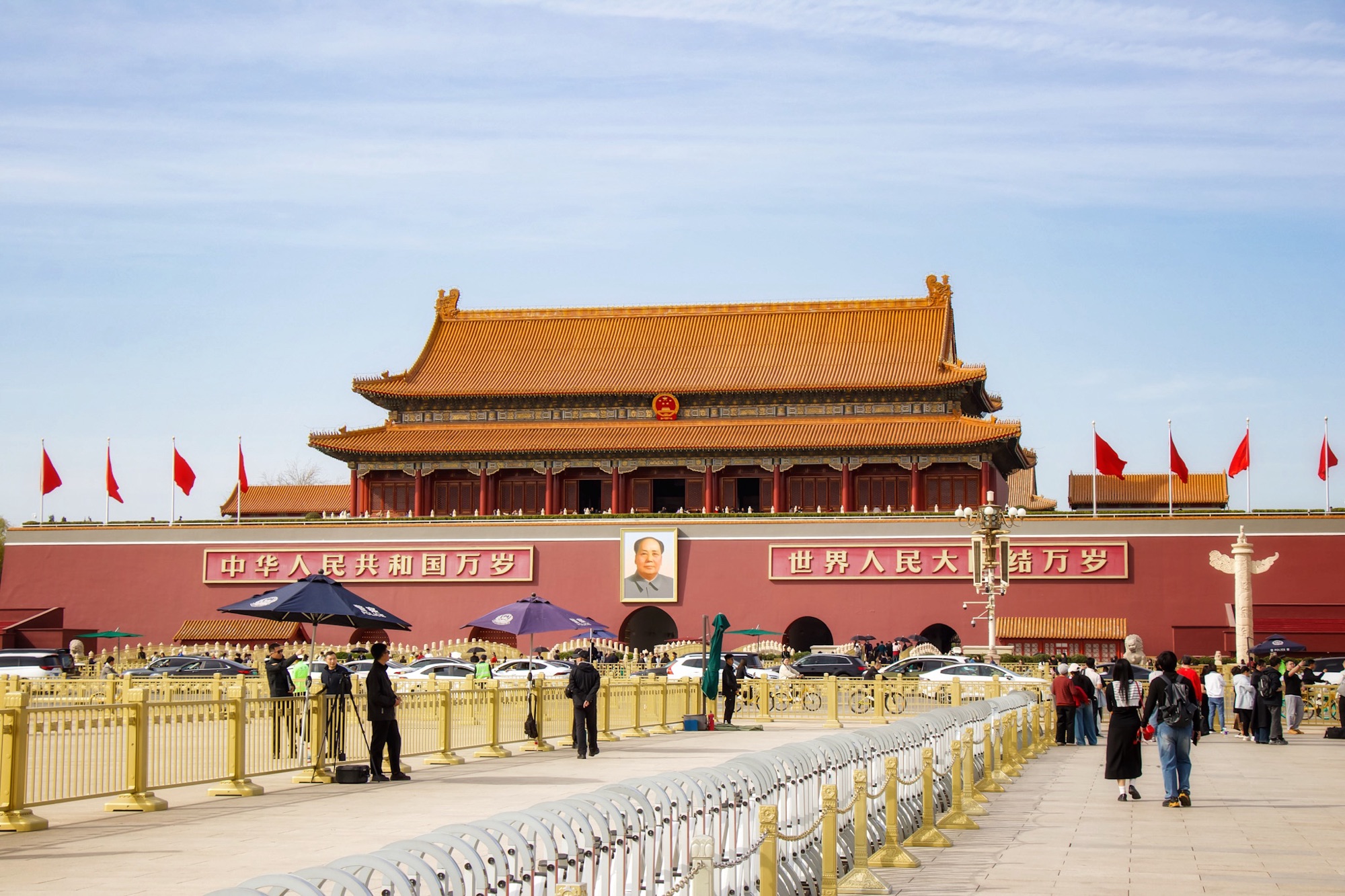
Last Updated on October 3, 2026 by Laura
If you are planning a trip to Beijing, you are probably already searching how to access one of the most heavily guarded places in the country: Tiananmen Square. Accessing this place, especially for foreign visitors, could be a quite stressful and challenging task. Indeed, visiting require meticulous preparation and willingness to follow rigid rules. In this blog, I will tell you everything you need to do for visiting Tiananmen Square as a tourist, including all the steps you need to follow before your trip.
New to China Traveling? 🇨🇳 Maybe you want to read the below!
- First timers’ guide to China
- Complete guide to visiting the Forbidden City
- Ultimate guide on how to visit the Great Wall of China
- How to visit the Terracotta Army in Xi’An
Table of Contents
A Brief History of Tiananmen Square

Tiananmen Square, or Tian’anmen Guangchang (天安门广场), is one of the most recognisable landmarks in Beijing. Its name comes from the Tiananmen, or “Gate of Heavenly Peace,” the imposing gate that stands at the northern end of the square and forms the southern entrance to the Forbidden City.
Although the square is closely associated with modern Chinese history, its story goes back much further. The area developed as part of the imperial centre of Beijing, with Tiananmen Gate forming an important entrance to the imperial city. The vast public square that visitors see today, however, is largely a product of the 20th century.
The May Fourth Movement
One of the earliest major political events associated with the square took place on 4 May 1919. Thousands of students gathered in Beijing to protest against the terms of the Treaty of Versailles, particularly the decision to transfer former German concessions in Shandong to Japan rather than return them to China.
The demonstrations became known as the May Fourth Movement and developed into a wider cultural and political movement. The events helped establish Tiananmen as an important location for public demonstrations and political expression.
The founding of the People’s Republic of China
Tiananmen Square gained an entirely new significance three decades later. On 1 October 1949, Mao Zedong proclaimed the establishment of the People’s Republic of China from Tiananmen Gate.
More than one million people reportedly attended the celebrations in the square. Since then, Tiananmen Square has remained an important symbol of the Chinese state and is the focal point of China’s annual National Day celebrations.
The enormous portrait of Mao Zedong that you can see today on Tiananmen Gate dates from this political transformation and has become one of the most recognisable images associated with Beijing.
Tiananmen Square in 1989
For international visitors, Tiananmen Square is perhaps most famously associated with the 1989 pro-democracy protests.
The demonstrations began in April 1989 following the death of Hu Yaobang, a former Communist Party leader associated with political reform. What began largely as student demonstrations developed into a much larger movement involving workers, intellectuals and other citizens. Protesters called for greater political freedom, democracy and freedom of expression. By May, enormous crowds had gathered in and around the square.
The Chinese government declared martial law in Beijing on 20 May. On the night of 3–4 June 1989, troops and tanks moved into central Beijing to suppress the demonstrations. Hundreds of people were killed, while estimates of the total number of deaths vary considerably; thousands were also arrested.
One of the most enduring images from the events is the photograph of an unidentified man standing in front of a column of tanks on 5 June 1989. Known internationally as “Tank Man,” the photograph became a symbol of individual resistance and is one of the most recognisable images of the 20th century.
Why is Tiananmen Square important today?
Today, Tiananmen Square is simultaneously a tourist attraction, political symbol and place of enormous historical significance. Its location places visitors at the heart of Beijing’s modern political landscape, surrounded by landmarks including Tiananmen Gate, the Forbidden City, the Monument to the People’s Heroes, the Great Hall of the People and the National Museum of China.
For visitors, it is worth remembering that Tiananmen Square is not simply another historic square in Beijing. It has been the setting for some of the most important and controversial events in modern Chinese history, from the May Fourth demonstrations and the founding of the People’s Republic of China to the 1989 protests.
Understanding some of this history before visiting makes the experience considerably more meaningful.
Essential information for your Tiananmen Square visit

In this section, you can find essential information for visiting Tiananmen Square as a tourist. I will also guide you guidance on how to book your tickets.
Can Tourists Visit Tiananmen Square?
Short answer, yes. But there is a catch. Indeed, Tianamen square is unlikely as any other square you have ever visited. Visitors can’t just pop there, have a selfie and leave. Each visit needs to be planned with exact entry and time date and even the gate chosen for the entry. This because each possible entry point is strictly surveilled by the police/army and all the visitors must have a reservation and pass all the security checks before accessing it.
WHY? Due to its history (read the paragraph before if you haven’t done it yet), the square is a sensitive political subject. Indeed, in the past people used it for mass gatherings and the heavy protests prompted the government to keep it under surveillance.
Do You Need a Reservation to Visit Tiananmen Square?
YES. A reservation via the WeChat mini program is mandatory for all the visitors. Impromptu visits are not allowed and you will be denied entrance without your reservation ticket. To note that the mini program is entirely in Chinese but recently they introduced an automated translation (there wasn’t when I booked so you are lucky!). To activate the translation click on the tree dots on the top right of the app and click the button “translate”.
Can You Take Photos in Tiananmen Square?
Yes. As a general rule, visitors can take photos in Tiananmen Square including during the flag raising ceremony, in the the Tiananmen Gate, and Chairman Mao’s portrait over it. However, there are some specific restrictions as follow:
- Drones are not allowed (this is valid in most of Beijing). You can even be jailed if caught flying a drone.
- Tripods are not allowed and will be confiscated during the security checks
- Large camera setups/professional camera might be questioned. I have personally being questioned for my Dji Osmo Pocket and had to show what pictures I took with my camera (Canon EOS 80D). Journalists with commissions might need specific permits to carry professional gears.
- Photography and video are strictly prohibited in the Mao Memorial Hall.
- Is better to avoid direct photograph of the on-duty police, armed guards, or soldiers. It might be inevitable to have a few of them in the background because the square is full of armed forces but just don’t photograph them on purpose or directly point a camera at them.
How Long Do You Need to Visit Tiananmen Square?
Tiananmen Square is quite big and with a lot of significative places to check out. The duration of your visit is up to you. It can take 30 mins as up to two hours if you want to check out each single building.
Best Time to Visit Tiananmen Square
If you are interested to the flag ceremonies, the best time to visit is (very early) in the morning or before the sunset. Indeed, for the “sun rising” ceremony is usually best to arrive at lease 60 mins before the sunrise, while for the flag lowering ceremony is best to arrive 30-60 mins before sunset. Timing depends on the time of the year.
If you are not interested in the flag ceremonies, any other time is ok. Remember that during the Golden Week and other national holidays queues to access the square might be extremely long.
Can You Visit Tiananmen Square and the Forbidden City on the Same Day?

Yes. This is also one of the best recommended routes to visit Beijing! Indeed, the Tiananmen Gate (the one with Chairman Mao’s portrait) is one of the most important access to the Forbidden City. Access from this gate is allowed only to those who have both reservations for the Tiananmen Square + Forbidden City.
I do recommend a minimum of 5 – 6 hours to visit both historical sites.
💡 Read my full guide to the Forbidden City here!
How to Book Your Visit to Tiananmen Square. Step-by-step guide
Now that you know the basis on how to plan your visit to Tiananmen Square is time to get into action and book that reservation!
To note that you can make your reservation only from 7 days prior to your visit and that reservations on the same day are not accepted.
Below you will find a step-by-step guide on how to make your reservation.
Step 1. WeChat Mini- Program

As a first step you have to download WeChat as this is essential to make your reservation. No WeChat – No tickets! If you never heard about this before, it’s a sort of WhatsApp.
Once you have WeChat active on your phone, go to Discover ➡️ Mini Programs
Here you can search either: 北京市人民政府天安门地区管理委员会 or Tiananmen Square Reservation.
You can access the mini-program also via this link.
TO NOTE: the app is only in Chinese, BUT there is an automated translation that can be activated by clicking the 3 dots on the top right of the page.
Step 2. Navigate the home page

Great! You managed to get to this point, you are halfway to get your reservation now! As soon as you launch the mini-program, you’ll face the home page of the reservation page. This is quite straightforward as it presents itself with only 3 options:
- 个人预约 (Individual Reservation). For people who are not a group (less than 10). This is what you need if you are a single traveller, couple or family.
- 旅游团预约 (Group Reservation). If you are part of a group (10+ people)
- 天安门地区参观预约平台 (Tiananmen Area Visit Reservation Platform). This is a centralised area for all the reservation services related to the Tiananmen area (e.g. The National Museum of China, Chairman Mao Memorial etc). It offers a centralised hub for accessing reservation options, visitor policies, and operational updates.
There are two further buttons at the bottom of the page that you might be curious about. The first on the bottom left side “预约须知” are the guiding rules for the reservation. The second on the bottom right side “预约记录” is where you can access your reservations.
Step 3. Familiarise with the Tiananmen area map.


Once you have selected your type of ticket, the system will prompt a screen that it was quite unexpected to me. Indeed you’ll see a map of the square and its security check-points from where you can access the area. The map itself it’s not clickable at this stage, and, at the beginning, I wasn’t 100% what it was expected from me, but I soon understood that I needed to pick up one of the check-points. So, for the moment just memorise it as best as you can because you will find this map again later (this time in a clickable format). Scroll down to accept the T&C and go to the next step.
Step 4. Choosing your date and time

A soon as the preview map disappears, the system will take you to a page with numbers and dates. On the upper part you will see the week available for booking.
Remember that booking is possible only 7 days prior to the date!
On the lower part you’ll see the available times. There are 4 possible options:
- Flag raising 升旗
- Morning 上午 from 06.25 am to 12.00 pm
- Afternoon下午 from 12.00 pm to 16.30 pm
- Flag lowering and nighttime 降旗及夜间 from 16.22 to 20.30
To note that in my particular screenshot all 4 options were marked “available” but I believe there is a cap on the maximum number of visit per day so, depending on the period, some of these timings might go sold out. These will appear as grey and not clickable if this is the case.
Step 5. Choose your entrance side


Once you have selected your date/time the map you have seen at the beginning will appear again! This time the check-points have a clickable setting and you can pick up your preferred one. This become orange once you select it. To note that also the map is in only Chinese.
NOW. If you are unfamiliar with Beijing’s geography, I won’t recommend picking up a random point on the map as you might be on the complete opposite side of where you want to be. Moreover:
- the square is huge.
- The entire area is completely blocked off so no cars/buses/pedestrians can cross it unless having a reservation.
This means that you’ll likely need a taxi to take you all around the other side of the square because you can’t simply cross it by walking and you can’t bypass the blocked area that is quite massive.
So, before choosing your preferred check-point, I would recommend scouting the entire area on Amap (this is the best and most detailed app for China because you can’t use Google Maps).
Selecting a Check-point


Once you have located the area that is closer to your accommodation or point of arrival, match it with the map you have on the mini-program to check what is the best check-point for you. On the photos above you can see how the map matches with the real-life one on Amap. I’ve added some key landmarks to help you orientating.
I personally opted for 广场东侧路南安检04 (on the bottom right side) roughly translated as “Square East Road South Checkpoint 04“. Indeed, this was not only the closest check point to where I was arriving from my hotel, but also the one allowing me to see most of the square without doing back and forward. I just needed to walk from south to north towards the Forbidden City. If you don’t want to opt for this one, you still have other 4 options:
- 天安门西红墙安检01 (Tiananmen West Red Wall Checkpoint 01) -Upper left side on the map
- 天安门东红墙安检02 (Tiananmen East Red Wall Checkpoint 02) – Upper right side on the map
- 广场东侧路北安检03 (Square East Road North Checkpoint 03) – Right mid-side on the map
- 广场西侧路南安检07(含团队安检) (Square West Road South Checkpoint 07 – Includes Tour Groups) -Lower left side on the map
To note that I’m not 100% sure on how flexible they are if, by mistake, you pop up into the wrong check-in point. The reservation is pretty clear and states your check-point. At worst, they will probably re-direct you towards your correct entrance.
Step 6. Add your details and Confirm your reservation


Once you have done this last step and opted for a specific check-in point, you will need to add your details and confirm the reservation. Remember that you can book up to 10 people with a single-ticket reservation. For each person on that ticket you must add their passport, DOB and full name. This is mandatory and can’t be avoided.
Once you have added your personal details you can click the blue button and confirm your reservation. The last screen you will see will just summarise the data for your reservation.
Congratulation! You have now booked your reservation and ready to go on your trip!
TO NOTE: you won’t receive a confirmation email of the reservation and this is saved exclusively on the app. You’ll need to open the app to show your confirmation.
What Documents Do Tourists Need?
As any other thing in China, all tourists need a passport to both book and enter Tiananmen Square. The passport is linked to your reservation and will be asked at the check-in point. Don’t forget your passport or you won’t be allowed to enter!
How to Enter Tiananmen Square
Part 1. Pass the multi layered check-in system


Booking your reservation is 50% of the job. Now you are finally in China and not sure how this reservation will translate in your real-life visit because you don’t know what to expect. So, let me give you some insight on this! Of course, I will be much more useful to those who will chose the Square East Road South Checkpoint 04, but I assume most check-in points will function in a similar way.
First. There is not just one check-in point. The one signed on the map is just the final access point to the square, but the entire area is closed off and heavily patrolled. So, you’ll need to pass further 2-3 check-in points (depending on where you start your walk) before arriving at the final entrance checks.
What we found was: one initial check-in point. This was just a closed off area with barriers. They wanted to see our reservation and they let us in. We walked quite a bit before finding a second smaller check-in station. Here they checked again the reservation + passports and we passed all the bags through a small scanner. We walked another 10 mins at least before finding the final access point 04. The one where the proper checks are conducted. This was an airport-style check. There was a small queue to access this point. Also here the official asked for passports and reservation, they took our fingerprints + face scan.
A second part of the checks involved our bags. These have been checked manually by the police and here I have been questioned about my camera gears. Also, little Chris had a toy camera on his own and he was happy to show the police his random pictures.
The whole final check-in lasted about 10 mins. All the officials were very kind and we appreciated their work in maintaining the area safe for all the people visiting. We had also a nice conversation with one of the soldiers as they told us is very lucky to have twins children and send us their blessings. We were in China literally from 3 hours (and heavily jet-lagged) how nice!
Access the square

Once you have completed all the required check-in, you are free to access the square in all its glory. You will see that the square is heavily patrolled, especially in front of the buildings and at the crossroad with the Forbidden City but. However, aside from that, the atmosphere is quite relaxed. We spend around 30 mins roaming around taking photos, but we didn’t enter the different buildings. This because we had a timed entry to the Forbidden City and we didn’t want to miss our entrance.
If you are planning to check all the buildings in the square, I recommend to plan for 1-2 hours (better in the morning).
Things to see in Tiananmen Square
If you have time, there is actually a lot to see in Tiananmen Square. I grouped here the most important sights so that you can pinpoint them for your visit.
The National Museum of China

This is located on the eastern side of the square. The building lies in the square since 1959 but the museum it’s a relatively new construction being opened just from 2003 and renovated in 2011. It hosts a collection of more than 1.4 million items, and 48 exhibition halls. If you don’t know much about the Chinese culture and history this is probably one of the best places where to start learning as it’s the museum with the richest collection of Chinese cultural relics in the world. This was on my list of places to visit but with the kids I had a second thought as I didn’t know if the museum was kid-friendly and didn’t want to cause any inconvenience.
TO NOTE: the Museum is huge and can easily take a few hours to explore on its own. Make sure to take this into account if thinking to visit both the square and the Forbidden City.
Admission
Entry to the museum is free but you must have a reservation to access (in addition to the Tiananmen Square one). You can make the reservation online through the official website HERE. The website is in English. You can book also via the WeChat mini-program of the museum. A valid passport is needed for the reservation and must be taken with you to access the site.
The Great Hall Of The People
The Great Hall Of The People located on the west of the square, has a very similar architecture to the National Museum of China. Indeed, also this building was completed in a similar period in 1956. Differently from the museum, the Great Hall Of The People is used for legislative and ceremonial activities by the government of China.
Admission
Tourists are allowed to visit when there is no official program in place and the Congress is not in session. Tickets cost around 60 RMB and reservation can be done via WeChat mini-program.
The Memorial Hall For Chairman Mao
Also known as as the Mausoleum of Mao Zedong this is the final resting place of Mao Zedong, who was the Founding Father of the People’s Republic of China and chairman of the Chinese Communist Party (CCP) until his death in 1976. Mao’s embalmed body is publicly displayed inside.
Access
Access to the mausoleum is free but requires a reservation via WeChat. This can be done also via the Tiananmen Square mini-program reservation by choosing the third option ‘Tiananmen Area Visit Reservation Platform”
The Monument To The People’s Heroes

This is an imposing ten-story obelisk that was erected as a national monument of China to the martyrs of revolutionary struggle during the 19th and 20th centuries. It’s located on the southern-centre side of the square (not too far from the check-in point), it’s made entirely of granite and tall 38 mt.
Tiananmen Gate


Last but not least, one of the most famous sights of Tiananmen Square. The Tiananmen Gate (also known as Tiananmen Tower) and roughly translated as “Gate of Heavenly Peace”. This is considered the official entry gate to the Forbidden City and often associated as image symbol of Beijing. The original building dated 1420 but the one as we know it today is a reconstruction of the late 1960. Indeed, the gate was destroyed and rebuilt several times from its first construction. In 1949, Mao Zedong proclaimed the People’s Republic of China from the balcony, which now features a large portrait of him.
As already mentioned, this is the main gate allowing to access the Forbidden City. Nevertheless, only people with at Tiananmen Square reservation can use this access for the palace. Indeed, the corridor leading to the gate is completely closed off and accessible only from the square. People who don’t have the reservation can access the Forbidded City from one of the other gates.
Other landmarks in the Tiananmen area worth mentioning


There are other landmarks that are worth mentioning just on the boarder side of the square but not blocked (so accessible without need of the square reservation). One of these is Zhengyangmen, better known as Qianmen Gate. This gate was part of Beijing’s historical walls and lies on the south side of Tiananmen Square. It was originally built in 1419 during the Ming Dinasty and renovated in 1915.
Another landmark worth your attention is the Huabiao. This is a type of ceremonial column used in traditional Chinese architecture. Huabiao are traditionally erected in pairs in front of palaces and tombs. Older photos of Tiananmen Square show the Huabiao placed both in front of the gate but at the moment they can be found one at the front and one at the back. The Huabiao column is made of 3 different parts and at the top always features a beast called “Wangtianhou”, which in Chinese mythology, is one of the Nine Sons of Dragon.
Tiananmen Square Visiting Tips


From my personal experience, I can say that visiting Tiananmen Square was comparable to the rest of the attractions in China, just with a few extra layers of security. If I have to give you some tips, I would say:
- Don’t forget your passport! This as a general rule in China. Your passport is vital to go around and access places. Always keep this at hand.
- Keep your reservation ready available. If you don’t have connection, make sure to activate an Airalo E-sim to have internet as you go!
- Don’t arrive the last minute! If you have a morning appointment of which last entry is at 12.00, arrive at least 40 mins before (better 1 hour). The layered check-in system is quite time consuming and during peak periods it will probably take much longer to get through.
- Don’t bring drones, tripods or any huge camera settings. They will be confiscated.
- Avoid assuming you can simply walk into the square from the surrounding streets because it’s not the case. The whole area is closed off and visitors must follow the proper route and protocol visiting rules.
- Don’t be rude with the personnel. Many of them work very long hours and grant the security of citizen and visitors.
Tiananmen Square Visit FAQ

Yes! The square is entirely free to visit but visitors must have a reservation done via WeChat.
Yes as long as you have a reservation and the passport with you.
Yes. You don’t need a Chinese phone number to make a reservation, but you must have WeChat installed on your phone.
Yes. Both adults and children need a reservation. The system automatically recognise children tickets when putting their ID data.
No. Large size luggage are not allowed in the square. Only backpacks and small bags.
Yes. Night visits are allowed until 8 pm and must be pre-booked in advance.
Yes. You don’t need a guide to visit. I visited independently.
Plan your trip to China


No time to read? Pin it for later!


